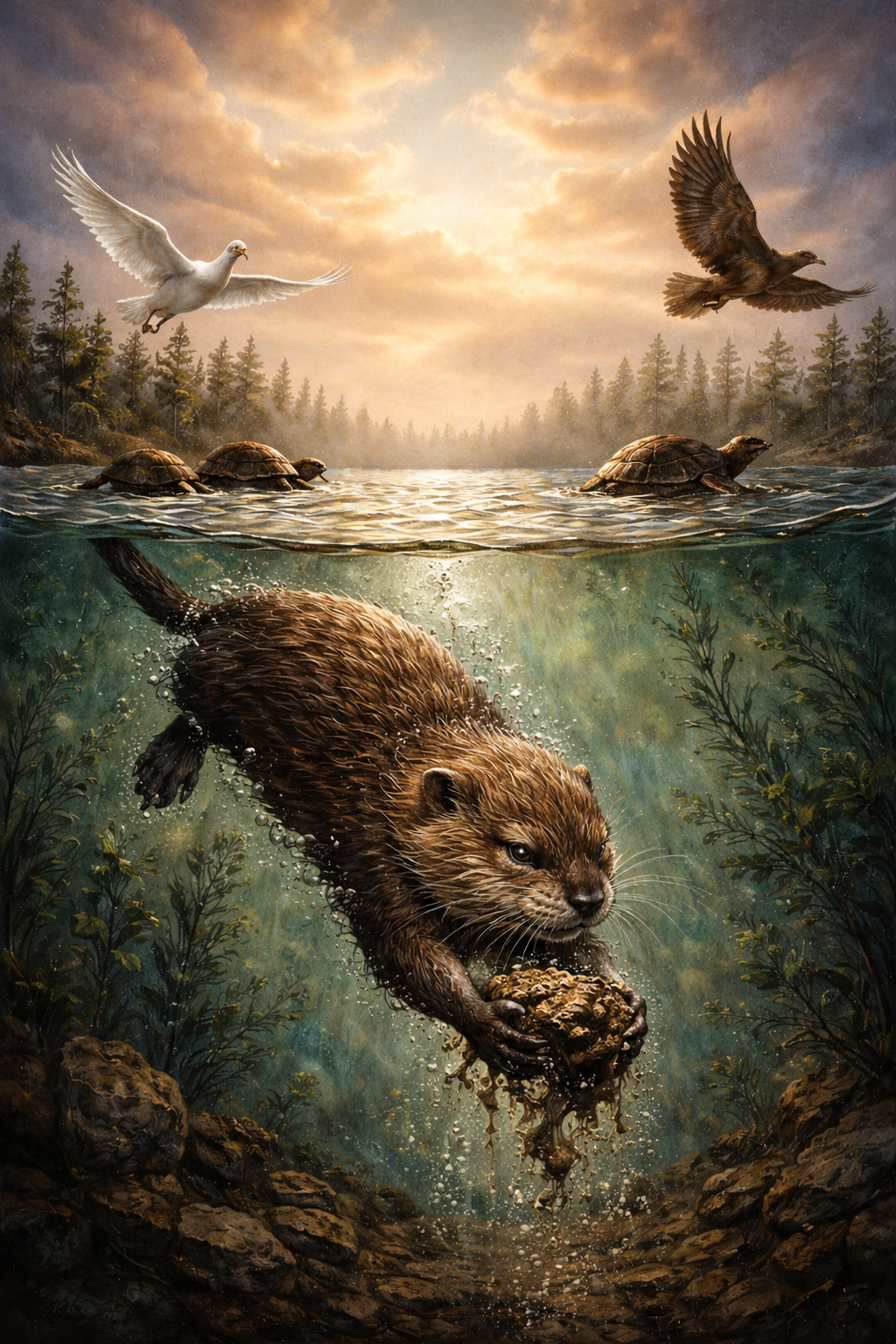
From Water to Land: The Earth Diver and the Flood Across Cultures
Across cultures, continents, and deep time, humanity has returned again and again to afoundational narrative pattern: a world submerged in water, a moment of rupture or emergence, and the subsequent formation—or re-formation—of land, life, and meaning. These narratives, while culturally distinct, reveal a striking continuity in how human societies conceptualize origins, catastrophe, and renewal.
Within the Cree and Ojibwe (Anishinaabe) traditions, creation begins not with destruction, but with undifferentiated potential. The world is entirely water—formless, expansive, and generative. In this primordial state, the Creator calls upon the animal beings to descend beneath the surface and retrieve the substance necessary for land. One by one, the most capable divers—the beaver, the loon—fail to reach the depths. It is the muskrat, small, humble, and often overlooked, who succeeds. Though the effort costs it its life, the muskrat returns with a fragment of earth clenched in its paw. This material is placed upon the back of the turtle, where it expands to become the land now known as Turtle Island.
This narrative, widely referred to as the Earth Diver motif, is among the most ancient and widely distributed mythological patterns, appearing across Indigenous North America, Siberia, and parts of Central Asia. Its persistence suggests not diffusion alone, but the enduring relevance of its underlying structure. The Earth Diver story encodes a relational understanding of being: creation is not an act of unilateral power, but one of cooperation, sacrifice, and interdependence among human, animal, and cosmic beings. The successful agent is not the strongest, but the most persistent and self-giving. In this sense, the narrative articulates a moral ecology in which humility and relational responsibility arefoundational to existence itself.
In contrast, the flood traditions of the ancient Near East and the Hebrew Bible present a different cosmological orientation. Here, the world already exists in structured form but becomes corrupted—morally, socially, or cosmically. In the Mesopotamian Epic of Gilgamesh and in the biblical account of Noah in the Book of Genesis, a catastrophic deluge is sent to cleanse the world. A chosen individual or family is instructed to construct a vessel, preserving a remnant of life through the destruction. When the waters recede, the world is not created anew from raw potential, but restored—reordered under a renewed covenant between the human and the divine.
These two narrative systems—Earth Diver and Flood—are not merely different stories, but distinct metaphysical orientations with similar imagry. The Earth Diver myth situates creation within a cooperative, multi-species framework and emphasizes emergence from depth. The flood narrative, by contrast, foregrounds moral rupture, divine judgment, and the preservation of order through selective survival. One begins in possibility; the other in crisis.
Despite these differences, both participate in a deeper archetypal structure. Drawing on the work of Joseph Campbell and Carl Jung, these narratives can be understood as expressions of the collective human psyche. In this framework, water consistently symbolizes the primordial—what Jung termed the unconscious: the undifferentiated ground of being from which form arises and to which it may return. The act of descent (in the Earth Diver story) or survival (in the flood narrative) represents a confrontation with this depth—an encounter with chaos, loss, or the unknown. The return—whether with ahandful of earth or a preserved lineage—marks the re-establishment of order and meaning.
From this perspective, two primary archetypal patterns emerge: The Earth Diver: a figure who descends into the depths and returns with the material or knowledge necessary for creation. This archetype emphasizes transformation through sacrifice, relationality, and emergence from below. The Flood Survivor: a figure who endures catastrophe and carries life forward through preservation. This archetype emphasizes continuity, moral order, and the resilience of structure through disruption.
Together, these patterns articulate a fundamental human insight: the world is not fixed orcomplete. It is continually subject to dissolution and renewal, and human beings areparticipants—rather than observers—in that process.
The contemporary relevance of these archetypes becomes particularly visible in projects grounded in cultural recovery and land-based knowledge systems. The Listening Lodge, as a conceptual and physical space, can be understood within this lineage—not as a reproduction of ancient narratives, but as a living enactment of their underlying principles.
Through the gathering of oral histories, language, music, and cultural memory, the Lodge functions as a site of descent and return. It engages with what has been submerged—historically, culturally, and psychologically—and brings it back into form through careful, relational practice.
In this sense, the Listening Lodge operates as a modern Earth Diver. It does not extract knowledge as resource, but retrieves it as relationship. It acknowledges that what is brought back—from memory, from land, from story—carries with it the weight of responsibility and the potential for renewal. Like the muskrat’s fragment of earth, these recovered elements are small, fragile, and profoundly generative.
To see the Listening Lodge in this way is not merely metaphorical. It orientates the project within a deep temporal and cross-cultural continuum of meaning-making practices. It recognizes that the work of remembering—of listening—is not passive, but creative. It is an act through which worlds are reconstituted.
In this light, the Lodge becomes more than a place of gathering. It becomes a site of cosmological participation: a space where the enduring human task of bringing land from water, and meaning from depth, continues.